
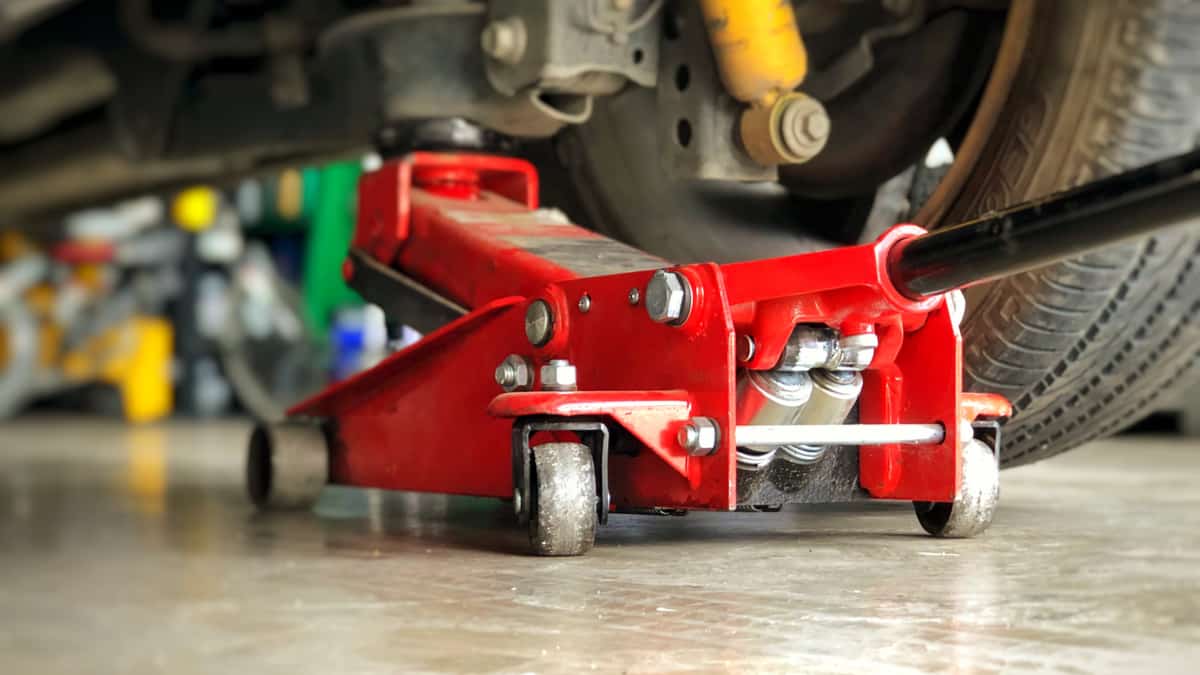
A floor jack can make tire, brake, and suspension work easier, but choosing one by ton rating alone can lead to a poor fit. The jack also needs to reach the vehicle’s approved lifting point and lift high enough for the job. Most importantly, a floor jack is for lifting. It is not a substitute for stands when you work under a vehicle.
Below are ten floor jacks to compare for different garage needs. Check the current product manual and specifications before buying, since model details can change. Use the safety section in this guide before lifting any vehicle.
This article may contain affiliate links. We may earn a commission on qualifying purchases at no extra cost to you.
10 Best Floor Jacks
1. Blackhawk B6350 – Best Floor Jack Overall

- Rated capacity: 3.5 tons
- Reported lifting range: 5.5 to 22 inches
The Blackhawk B6350 has a higher capacity and maximum lift than many compact garage jacks. Its fast-lift design can raise the saddle to the load with fewer pump strokes, and the swivel saddle helps position it at the lifting point. The built-in overload protection is a useful feature, but it does not make the jack suitable for loads beyond its rating or compensate for an incorrect lift point.
The main limitation is its minimum height. At about 5.5 inches, it may not fit beneath a lowered car or a vehicle with limited clearance at the approved lift point. Measure your vehicle and verify the current product specifications before buying.
- Pros: Higher rated capacity, fast-lift design, useful maximum height
- Cons: Minimum height may be too tall for some cars; heavy to move and store
2. Performance Tool W1606 Compact – Best Budget Option

- Rated capacity: 2 tons
- Reported lifting range: 5 to 15.5 inches
The W1606 is a compact trolley jack for someone who wants a smaller, lower-cost option for occasional garage use. Its overload bypass is intended to help prevent over-pumping beyond the jack’s design limits. The compact size can also make it easier to store than a full-size shop jack.
Its 2-ton rating and limited lifting range narrow the applications it can handle. The 5-inch minimum height may not fit some low-clearance vehicles, while the maximum height may not provide enough room for some jobs. Check your vehicle’s manual and the jack’s current specifications before deciding it will work for your car.
- Pros: Compact, relatively affordable, 2-ton capacity for suitable applications
- Cons: Limited lifting range; may not fit low cars or provide enough height for some jobs
3. AFF 400SS Dual-Pump Floor Jack – Premium Choice

- Rated capacity: 4 tons
- Reported lifting range: 4.3 to 20.5 inches
The AFF 400SS is a heavier shop-style jack with a dual-pump hydraulic system and a 4-ton rating. Its reported range gives it more maximum lift than many compact jacks, while its minimum height is lower than a standard service jack. These features can make it useful in a busy garage where the jack is moved between different vehicles.
It is large, heavy, and generally more expensive than a basic home-garage jack. The 4-ton rating also does not mean it can lift any vehicle at any point. Follow the jack instructions and vehicle lift-point information, and confirm the current capacity and range before purchase.
- Pros: Dual-pump system, higher rated capacity, broad reported lifting range
- Cons: Heavy and costly; may be more jack than needed for occasional use
4. Pro Eagle Big Wheel – Best for Off-Road Use

- Rated capacity: 3 tons
- Reported lifting range: 6 to 28 inches, depending on model and extension
The Big Wheel design is aimed at off-road vehicles and lifted trucks. Its larger wheels are intended to roll over rougher terrain more easily than the small casters on a typical garage jack, and its high lift can suit vehicles that sit well above the ground. The model shown has a reported 3-ton capacity, but check the exact version and extension configuration.
This is a specialized and relatively expensive option, and its 6-inch minimum height makes it unsuitable for many passenger cars. Large wheels do not make an unstable surface safe. Use the jack only on a firm, level base and follow the manufacturer’s instructions for the terrain and lifting setup.
- Pros: High lift for suitable trucks, large wheels, designed for off-road applications
- Cons: Expensive, tall minimum height, not a general-purpose low-car jack
5. Liftmaster 3-Ton Ultra-Low-Profile – Best for Low Cars

- Rated capacity: 3 tons
- Reported lifting range: 3 to 20 inches
The Liftmaster’s low starting height is its main advantage. A jack that fits beneath a lowered car can save time compared with using ramps or removing a wheel to create clearance. Its dual-pump design is intended to raise the saddle more quickly, and the model is listed with a maximum height that can work for some SUVs and trucks.
Check the current listing and manual before relying on those measurements, since product specifications can vary by model. Also measure the vehicle at the approved lifting point. A low-profile jack may still be too tall for some lowered vehicles, and its maximum height may not be enough for every repair.
- Pros: Low minimum height, dual-pump design, useful reported maximum lift
- Cons: Model details and availability should be verified; may still not fit some lowered cars
6. Pittsburgh Automotive Heavy-Duty Low-Profile Jack

- Rated capacity: 3 tons
- Reported lifting range: about 3 to 19.75 inches, depending on model
The Pittsburgh low-profile model combines a low minimum height with a higher maximum lift than many compact jacks. A dual-piston pump is designed to reduce the number of strokes needed to raise the saddle. Its wider base and universal-joint release are also listed as design features.
There are several Pittsburgh jack versions, so confirm the exact model and dimensions on the current listing. Do not rely on the product name alone when checking whether it fits beneath your vehicle. It is also a heavy steel jack, so consider how much room you have to store and move it.
- Pros: Low-profile design, dual-piston pump on listed versions, broad reported lift range
- Cons: Heavy; specifications differ between versions
7. BIG RED T83006 Torin Hydraulic Trolley Jack

- Rated capacity: 3 tons without the SUV adapter; 2.5 tons with the adapter
- Reported lifting range: 5-7/8 to 17-1/4 inches without the adapter; 9-1/4 to 20-7/8 inches with it
The T83006 is a basic trolley jack with a long handle and a single-piston pump. Its standard configuration is aimed at vehicles with enough clearance for its higher minimum height. Torin also lists a separate SUV adapter configuration, which changes both the capacity and lifting range.
That distinction matters: do not use the standard 3-ton rating with the adapter. Check the label and the manual for the exact setup you own. This jack is less suitable for lowered cars, and the single-piston design may take more strokes than a dual-pump jack.
- Pros: Long handle, straightforward design, adapter option for additional lift
- Cons: High minimum height without adapter; capacity changes when the adapter is used; single-piston pump
8. Arcan A20018 3-Ton Quick-Rise Aluminum Jack

- Rated capacity: 3 tons
- Reported lifting range: about 3.75 to 18 inches
The A20018 is an aluminum floor jack with a dual-pump design. Its lighter construction can make it easier to move around a garage than a comparable steel jack. The listed minimum height can also suit some cars that will not clear a standard-height service jack.
Its reported maximum height is lower than some steel jacks, so it may not provide enough clearance for every truck or repair. Aluminum construction also does not remove the need to inspect the jack, follow the capacity limit, and use stands before working underneath the vehicle.
- Pros: Lighter than many steel jacks, dual-pump design, low minimum height
- Cons: Lower maximum height than some alternatives; typically costs more than basic steel models
9. Powerbuilt Extra-Low-Profile Floor Jack

- Rated capacity: 2 tons
- Reported lifting range: about 2.75 to 15.5 inches
The Powerbuilt jack’s low saddle can fit beneath some vehicles with very little ground clearance. The wide saddle and built-in locking bar are notable features of this design. The locking bar is specific to this product; follow its manual for the intended lifting and support procedure rather than assuming it applies to other floor jacks.
The 2-ton capacity and 15.5-inch reported maximum height limit the vehicles and jobs it can handle. Confirm the exact model number before ordering, as this product is sometimes listed with different model-number formatting. Check the product manual to see whether the jack fits your vehicle and the work you plan to do.
- Pros: Very low minimum height, wide saddle, built-in locking bar
- Cons: 2-ton capacity; limited maximum lift; model number should be verified before purchase
10. Pro-Lift F-767 Grey Low-Profile Jack

- Rated capacity: 2 tons
- Reported lifting range: about 3.5 to 14 inches
The F-767 is a compact steel jack with a low starting height and a 2-ton rating. Its size can suit some passenger-car work and makes it easier to store than a larger shop jack. The listed bypass and overload-protection features are intended to protect the jack, but do not replace checking the capacity and using the jack as instructed.
The maximum height is limited compared with larger floor jacks, so it may not provide enough room for some vehicles or jobs. Check your vehicle’s clearance and required lift height, and confirm the current product specifications before buying.
- Pros: Compact, low minimum height, suitable for some passenger-car applications
- Cons: 2-ton capacity and limited maximum height may rule out larger vehicles and some repairs
How to Choose a Floor Jack
Check the approved lifting point
Use the vehicle owner’s manual or service information to find the approved lifting points. Do not assume that a frame rail, axle, pinch weld, or center point is safe to lift on every vehicle. Some cars need a specific adapter to avoid damaging the body or undercarriage.
Compare the capacity and lifting range
Use the jack only within its rated capacity and for the applications listed by its manufacturer. There is no universal calculation based on vehicle weight that guarantees a particular jack is suitable. If the manual does not clearly cover your vehicle or lifting setup, ask a qualified technician.
Measure the clearance at the lift point and check both the jack’s minimum and maximum heights. Also consider whether the jack will roll freely as the lifting arm rises. Follow the manufacturer’s instructions for the jack’s setup and use.
Use a jack stand for under-car work
A hydraulic floor jack can lower or fail to hold a load. If you need to work under the vehicle, support it with stands that are rated for the load and placed at the vehicle manufacturer’s approved support points. A locking feature on a jack does not automatically replace stands unless the product is specifically designed and approved to lift and support a vehicle in that configuration.
How to Use a Floor Jack Safely
- Choose a firm, level surface. Do not lift a vehicle on a slope, soft ground, gravel, or a surface that may shift.
- Secure the vehicle. Turn off the engine, apply the parking brake, select Park or a gear, and chock the wheels that remain on the ground.
- Inspect the jack and stands. Do not use equipment with leaks, bent parts, damaged welds, or missing components. Check the instructions and rated capacity.
- Position the jack at the specified lifting point. Use only the point and adapter approved for the vehicle. Keep your hands clear of pinch points.
- Raise the vehicle slowly. Watch for movement, slipping, or instability. If anything shifts, lower the vehicle and reassess the setup before trying again.
- Place the stands at approved support points. Make sure the stands are correctly positioned and locked according to their instructions.
- Lower the vehicle onto the stands. Confirm the vehicle is supported by the stands before going underneath. Never rely on the floor jack alone.
Do not push or shake a raised vehicle to test it. If the setup looks unstable or you are unsure whether the stands are carrying the load, stay clear and lower the vehicle. Do not get under it until the support setup is corrected.
Frequently Asked Questions
Can I work under a car supported by a floor jack?
No. A floor jack is for lifting, not for supporting a vehicle while you work underneath it. Use correctly rated stands at the vehicle’s approved support points.
Is a 3-ton floor jack enough for any car?
No. The rating alone does not confirm that the jack is appropriate for a particular vehicle or lifting point. Check the vehicle and jack manuals, including any adapter or configuration limits.
Can I use a floor jack on a sloped driveway?
Do not lift a vehicle on a slope or unstable surface. The jack can shift as the vehicle rises. Move to firm, level ground before lifting.