
This message can appear even when the car starts, steers, and brakes normally, so it may be tempting to put it off. But normal driving behavior does not show whether the restraint system is ready for a crash.
Here’s how to interpret the warning and what to check next.
What does the Service Safety Restraint System warning mean?
The SRS monitors components involved in occupant protection during a crash. If the system detects an electrical or component fault, it may display a message such as “Service Safety Restraint System,” “Service Airbag System,” or illuminate the airbag warning light. The wording varies by make and model.
A warning means the restraint system may not work as intended. Depending on the fault, an airbag or seat-belt pretensioner could be affected. The message alone cannot tell you which component is involved or whether every airbag is affected. A scan tool that can read the SRS module is needed to identify the stored fault codes.
Many vehicles briefly illuminate the SRS light during the startup check. If it stays on, appears while driving, or does not illuminate at startup, check your owner’s manual and arrange an inspection promptly.
What parts can cause the warning?
The message can be triggered by different faults. These are possibilities to investigate, not proof that a specific part has failed.
Wiring or connector fault
A damaged wire, poor connection, or corrosion can interrupt communication with an SRS component. The fault code may point to a circuit, but the circuit needs to be tested before a part is replaced. Do not unplug, probe, or test SRS wiring yourself.
Clock spring fault
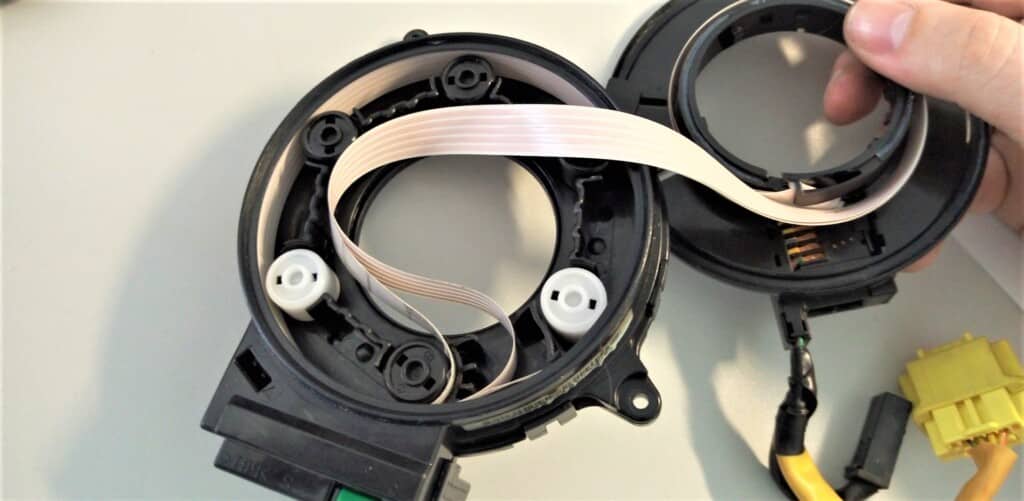
The clock spring maintains an electrical connection to certain steering-wheel components as the wheel turns. If it develops a fault, the driver’s airbag circuit or steering-wheel controls may be affected. A warning light alone does not confirm a bad clock spring. See our guide to clock spring symptoms.
Seat, seat-belt, or occupant-detection fault
Depending on the vehicle, the SRS may monitor seat-belt buckles, pretensioners, and sensors that help determine whether a passenger is in the seat. A fault in one of these components or its wiring can trigger a warning. Avoid disconnecting connectors under a seat as a troubleshooting step.
Sensor or control-module fault

The system uses sensors and a control module to monitor restraint-system components. A stored code may indicate a problem in a sensor circuit or module, but it does not always prove the sensor or module itself is defective. Follow the vehicle-specific diagnostic procedure before replacing anything. You can read more about airbag sensor faults.
Low voltage, water intrusion, or collision damage
Low battery voltage or a power interruption can set an SRS code on some vehicles. Water intrusion, corrosion, or collision damage can also affect SRS wiring and components. These are clues to share with the technician, not a reason to assume the cause or clear the code without diagnosis.
How to diagnose the warning
Start by reading the SRS codes with a compatible scan tool. A basic engine-code reader may not communicate with the airbag module. The code helps narrow down the affected circuit or condition, but testing is still needed to confirm the cause.

- Record the warning and any messages. Note when the warning appears and whether other lights or messages are present.
- Scan the SRS module. Use a tool that can access airbag and restraint-system codes, not only engine codes.
- Use the code to guide testing. A circuit code does not automatically mean the named sensor or component needs replacement.
- Repair the confirmed fault. Follow the service information for the exact vehicle.
- Clear the code and verify the repair. After the repair, use the correct procedure to clear codes and confirm the warning does not return.
If you do not have an SRS-capable scanner or the service information for your vehicle, take it to a qualified repair shop. Our guide to OBD2 scanners explains why tool coverage matters. For a related overview, see what the SRS light means.
Can you drive with the warning on?
The vehicle may continue to drive normally, but the warning means some crash-protection functions may not work as intended. Arrange an inspection as soon as possible and avoid unnecessary driving until the system is checked. If you need to drive it to a repair shop, wear your seat belt and make sure passengers are properly restrained.
Do not try to turn the warning off by pulling a fuse, installing a bypass, or probing wiring. SRS components require vehicle-specific service procedures. Incorrect handling can cause injury or damage.
How much does it cost to fix a Service SRS warning?
There is no single repair price because the message can have several causes. The total depends on diagnosis time, the component that has actually failed, and whether programming or calibration is required. Ask the shop for the SRS codes and test results that support its estimate before approving parts replacement.
Frequently asked questions
Does this message mean the airbags will not deploy?
Not necessarily. The message means the SRS has detected a fault, but it does not reveal which components are affected. An airbag or pretensioner may not work as intended. A scan and diagnosis are needed to determine the fault.
Can I reset the Service Safety Restraint System warning?
Clearing the code does not fix the underlying fault. Diagnose and repair the cause first, then clear the code using an SRS-capable tool and the vehicle’s procedure. If the warning returns, the fault remains or another problem needs diagnosis.
Could a weak battery cause the warning?
Low voltage can set an SRS code on some vehicles, but it is only one possible cause. Scan the SRS module and follow the diagnostic procedure rather than assuming a battery charge or reset will resolve it.